Friday, June 6, 2008

Mitsubishi Ralliart Evolution Challenge Ireland 4th round to be the ALMC City North Hotel Stages Rally

Organizers of the Mitsubishi Ralliart Evolution Challenge Ireland have today announced that round four of the Eire-based one-make series for Group N Lancer Evolutions will be the ALMC City North Hotel Stages Rally on 6th July, in place of the Topaz International Donegal Rally on 14th & 15th June, which was initially included in the Mitsubishi championship’s six-round calendar.

The move has come about following concerns that not all of the registered Evolution Challenge teams would be able to gain an entry in Donegal, a scenario that was considered unfair for those who would not be able to compete, as Championship Manager Simon Slade explains:

“We initially included Donegal because of the rally's excellent reputation. However, as the event got nearer we became aware that it would be difficult to ensure that all of our crews would get an entry. It’s a shame, but we fully understand the situation the rally organizers have, with it being so oversubscribed. We therefore looked at moving to another event and the ALMC Stages just outside Dublin on 6th July fitted into our calendar very well.”

Slade continues: “Although some of our competitors would have liked Donegal to remain as a round of the Evo Challenge, they understand the reason why we have had to make the change. However, with the two events a few weeks apart, it still allows competitors to compete in both if they wish.”

Clerk of the Course for the ALMC Stages Rally John Carroll is delighted that his event has been selected as a round of the Mitsubishi championship:

“The ALMC Motor Club welcomes the Evolution Challenge. Whilst traditionally a Clubman’s event, we are now building-up its status and see the inclusion of the Mitsubishi championship as a step towards this. It is also rewarding for the ALMC members in light of their hard work over the last few years. We are confident that the drivers will not be disappointed with the stages we have in store.”

The ALMC Stages Rally will be based at the City North Hotel, approximately 40 kms from Dublin on the M1 motorway. The event will feature three stages ran three times, with a central service area. All of the event’s 145 competitive kms will take place in County Meath.

The 2008 Mitsubishi Ralliart Evolution Challenge Ireland is supported by: Sunoco Racing Fuels, Pirelli tires, Mitsubishi Motors Ireland, Performance Friction Brakes, Speedline Corse wheels, PIAA lights, Murray Motorsport, Sparco racewear, Pacenotes and James Foley Rallysport, who are providing a Group N Lancer Evolution for the 2008 Champion to use in next year’s Rally Ireland.

Saturday, May 31, 2008

Yet another Victory for the EVO IX in Cyprus Rally

The Cyprus Rally, round 2 of the 2008 FIA Middle East Championship (MERC), came to an exciting climax today, with victory for Cypriot Nicos Thomas and co-driver SG Chips in their Mitsubishi Lancer Evolution IX.

Fellow Cypriot Savvas Savva and co-driver Pambos Laos secured second place in their Mitsubishi Lancer Evo VIII, finishing the event 26.2 seconds behind Thomas.

Pre-event, attention was expected to be focussed on Qatar's Nasser Saleh Al-Attiyah and his Ulster co-driver Chris Patterson in their Subaru Impreza WRX N14, and Jordan's Amjad Farrah and Tina Maria Monego - who started 2nd in their Mitsubishi Lancer Evo IX.

This weekend's event attracted a host of famous faces from across the region, including Saudi Arabia's Yazeed Al-Rajihi, Qatar's Misfer Al-Mari, Souhail Al-Maktoum of the UAE, Lebanon's Michel Saleh and Nick Georgiou, Qatar's Khalifa Al-Attiyah, Salah Bin Eidan of Kuwait, and Nizar Al-Shanfari of Oman.

The international field was largely decimated over the weekend's action, however, with only three finishing in the top ten: Al-Attiyah in 3rd, Nick Georgiou 6th and Al-Mari 9th.

Thomas' victory makes him the second Cypriot driver to win the Cyprus Rally since 1991, after Charalambos Timotheou won here last year. At 20 years of age, not only is Thomas the youngest driver ever to win the Cyprus Rally, his win also makes him the youngest driver to ever win a Middle East Rally Championship event.

>From Day 1, the event belonged to 20-year-old Cypriot driver Nicos Thomas and co-driver SG Chips, who held a 12.9 second overnight lead in their Mitsubishi Lancer Evolution IX.

The weekend's action got underway at 0830 yesterday morning from the service park on Limassol's seafront promenade; 49 crews started the event. Cypriot drivers enjoyed considerable success from the outset and Constantinos Tingirides and Angelos Loizides set the pace early on in their Subaru Impreza N12, storming to an impressive lead over the morning's first two special stages.

SS1 (Lagoudera - Kapouras) saw an outstanding drive from current Cyprus Championship leader Tingirides, setting an impressive time of just 16m 08.6s, with the Mitsubishi Evolution VII of Paraskevas Paraskeva and Yiannos Evripidou 11.8 seconds behind. Stavros Antoniou and Nicos Thomas finished the stage 3rd and 4th fastest consecutively. Technical problems plagued Al-Attiyah and the best he could manage was 11th fastest, 41.2 seconds behind Tingirides. Farrah was back in 13th, 51.7 seconds off the leader. All 49 cars which started the rally completed SS1.

Speaking at lunchtime service on Leg 1, both Al-Attiyah and Farrah admitted they were losing time heavily due to mechanical problems. Al-Attiyah was suffering loss of power due to what was thought to be an internal engine problem, but which later turned out to be electrical. Farrah's loss of 1st and 2nd gears made scoring good times on the challenging Cyprus stages impossible.

Tingirides continued to lead the way in SS2 (Kourdali - Ag. Theodoros), setting fastest time through the stage, with Paraskeva 18.6 seconds behind overall. Savvas Savva came in 3rd fastest in his Evo VIII, with Nicos Thomas 4th. Saudi Arabia's Yazeed Al-Rajihi was 5th in his Subaru Impreza 2008, followed by Souhail Al-Maktoum of the UAE, also in a Subaru.

SS3 (Orkontas - Galata) saw Tingirides drop dramatically back to 12th fastest due to a puncture, while Stavros Antoniou made a spectacular comeback (after a puncture in SS2) to finish fastest on the stage. Pantelis Pambouka came in 2nd in his Subaru Impreza, 11.1 seconds behind Antoniou; Al-Rajihi and Savvas were 3rd and 4th fastest through the stage. Thomas came in 5th fastest, placing him 2nd overall, 23.8 seconds behind rally leader Savvas Savva. Nick Georgiou (Evo IX) was 6th fastest through SS3, followed by Andreas Tsouloftas in 7th. Al-Attiyah's problems continued, leaving him 14th fastest through the stage and 9th overall, whilst Farrah finished the stage 16th and 15th overall.

The teams returned to Limassol service after lunch, then headed out again to tackle the last stage of the day, SS4 (Anadiou - Anadiou). While Al-Attiyah was unconvinced that his technical woes were over, he vowed to press on and secure the best result possible. Tingirides, still smarting from losing time in SS3, left service planning to "go flat out in stage 4".

Tingirides kept to his word, bouncing back in the long and challenging final stage of the day to set the fastest time, with Nicos Thomas just 0.3 seconds behind through the stage. Stavros Antoniou managed 3rd fastest through SS4, and Al-Attiyah did all he could to be 4th fastest. Amjad Farrah, still struggling with transmission problems, could only manage 11th.

Ahead of Day 2, the top five MERC drivers were Nick Thomas, Yazeed Al-Rajihi, Nick Georgiou, Nasser Al-Attiyah, and Amjad Farrah. But things went from bad to worse for Farrah in evening service, when his gearbox change hit problems and he overran his service time, resulting in his exclusion. His team acknowledged that this wasn't good in terms of the championship, but hope that the next event will go better.

There was a positive atmosphere at the start on Sunday. Al-Attiyah in particular was upbeat, confident that the previous day's problem had turned out to be an electrical fault, which his mechanics had managed to resolve. Overnight leader Thomas was also quietly confident. Having rectified his power steering problems, he set out for a steady drive, hoping for a podium finish.

Al-Attitah's positive mood was quickly justified, as he set fastest time through the first stage of the day, SS5 (Foini - Koilinia), ahead of Tingirides and Al-Rajihi. Stavros Antoniou and Savvas Savva came through the stage 4th and 5th fastest respectively, while Nicos Thomas did enough to maintain his overall lead with a measured drive - 6th fastest through the stage.

Al-Attiyah was pushing hard all morning to make up for time lost yesterday. He flew through SS6 in 33m 22.5s, and Nicos Thomas responded - setting 2nd fastest time just 0.4 seconds behind, which was enough to maintain his overall lead into lunchtime service. Savvas Savva finished SS6 as 3rd fastest, with Stavros Antoniou 4th fastest and Pantelis Pamboukka 5th.

In lunchtime service, Al-Attiyah admitted that there was a lot of time to make up, "But let's see".

Thomas acknowledged that Al-Attiyah was fighting back, but he remained calm, saying that he was just going "to keep doing the same and hope to do well".

Al-Attiyah kept up his attack on SS7 (Anadiou - Anatiou Short 2), taking the stage just 0.1 seconds ahead of Thomas. Savvas Savva was 3rd fastest, with Pantelis Pamboukka and Leonidas Christofi in their Subaru Impreza STi N12 4th.

Thomas' spirited response to Al-Attiyah's challenge saw him maintain his overall lead going into the final stage of the event, SS8 (Panagia - Arminou). Al-Attiyah lost considerable time in the last stage and could only manage 9th fastest. Pamboukka showed a final burst of speed to take the final stage of the event, but another assured drive from Thomas saw him clinch victory when he went second fastest through the stage.

While Al-Attiyah would have liked a repeat of his many recent victories in Cyprus, he will no doubt be satisfied after his difficult first day to leave Cyprus with 8 points and his MERC lead intact.

Rallies in Cyprus are known for their friendly atmosphere and the 2008 event was no different, with warm temperatures and plenty of sunshine.

Revamped for 2008, the Cyprus Rally is more than ready for its return to the FIA World Rally Championship (WRC) calendar next year. This weekend's event features a combination of new special stages, stages which were first introduced last year, and a selection of classic stages. It is noteworthy that an outstanding 80 percent of the stages are used just once through the course of the event.

The stages met with a largely positive reception from the drivers, most of whom acknowledge that the event remains tough, but most seemed to be enjoying themselves.

The Finish Ceremony and prize giving took place Limassol's seafront promenade later in the afternoon.

The very latest technology was employed for monitoring and timekeeping the event and the official website - http://www.cyprusrally.com.cy - was regularly updated over the weekend to keep everyone in touch with the action.

The Cyprus Rally is organized by the Cyprus Automobile Association (CAA), with support from the Cyprus Tourism Organization, and is sponsored by Cyta, Golden Telecom, Coca Cola Zero, Compusource and Travelscope.

Cyprus hosts two rounds of the FIA Middle East Rally Championship this year. The Troodos Rally, round 6 of the 2008 MERC and the penultimate event in this year's calendar, will be held in Cyprus on 7/9 November.

Friday, May 23, 2008

The Ancestors… Part III

www.autopartswarehouse.com

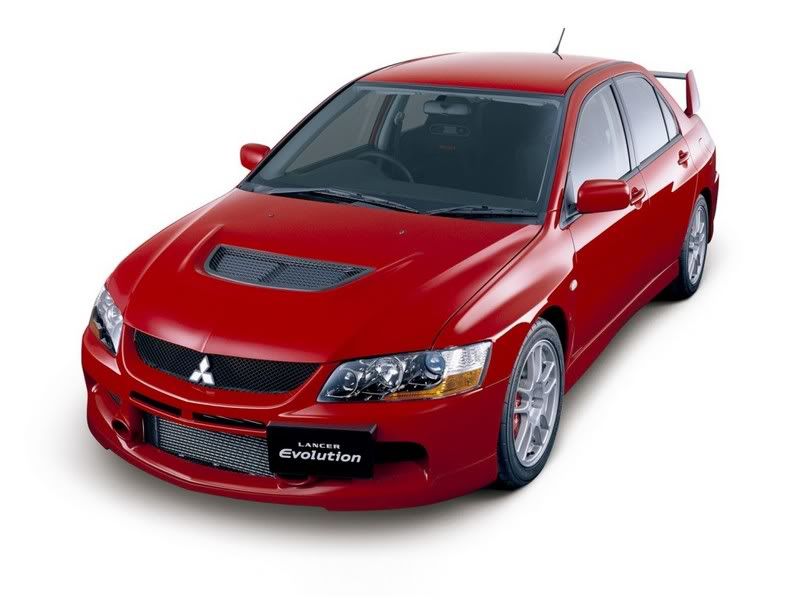
The final two cars before arriving at magic number 10 are the Misubishi EVO VII and IX. Both of these cars are every bit the workhorse their ancestors are. Let’s review each of these wonderful pieces of machinery.

The Evolution was changed again in 2003, this time sporting Super Active Yaw Control to handle traction and a 6-speed manual gearbox. It was available with 280 PS (276 hp/206 kW) in three trims: standard (GSR in Japan), RS (devoid of all excess components, such as interior map lights, power windows/doors, and radio) and MR. RS Editions came with a revised limited-slip front differential. The new Evolution also sported Altezza taillights.

The Lancer Evolution VIII MR uses slick-response Bilstein shocks for improved handling. The aluminium roof panel and other reductions in body weight have lowered the centre of gravity to realize more natural roll characteristics. Detail improvements have also been made to Mitsubishi’s own electronic all-wheel drive, to the ACD 5 + Super AYC 6 traction control and to the Sports ABS systems. The Lancer Evolution VIII displayed at the 2003 Tokyo Motor Show took the MR designation traditionally reserved for Mitsubishi Motors high-performance models and used first on the Galant GTO. Other parts on the MR include BBS alloy wheels, Bilstein shocks, and an aluminium roof. In the United Kingdom, many special Evolutions were introduced, which included FQ300, FQ320, FQ340, and FQ400 variants. They each came with 305, 320, 340, and 400 hp (227, 239, 254 and 298 kW), respectively. It is rumored that the 'FQ' stands for 'Fucking Quick'.

The FQ400, sold through Ralliart UK, produces 302.13 kW (405.2 hp), from its 2.0 L 4G63 engine as the result of being specially modified by United Kingdom tuning firms Rampage Tuning, Owen Developments, and Flow Race Engines. At 202.9 hp (151.3 kW) per litre, it has one of the highest specific output per litre of any roadcar engine. With a curb weight of around 3200 lb (1450 kg), it achieves a 0-60 mi/h in 3.5 seconds and a 0-100 mi/h in around 9 seconds , top speed is 174 mi/h (280km/h), while costing about £47,000. BBC's television series Top Gear demonstrated that the FQ-400 could surprisingly keep up with a Lamborghini Murcielago around a test track. The Stig recorded a Top Gear Power Lap Times of 1 minute 24.8 seconds, slower than the Murcielago, but highly respectable nonetheless. In a similar test conducted by UK supercar magazine evo, the Evolution was able to lap the Bedford Autodrome faster than an Audi RS4 and a Porsche Carrera 4S.[citation needed]

The Lancer Evolution VIII was also the first Evolution to be sold in the United States, spurred by the success of the Subaru Impreza WRX which had been released there just three years prior. The Evolution VIII found its true competition in the Subaru Impreza WRX STI model the same year as the Evolution VIII's US introduction. However, the internal components for the American versions were largely stripped-down versions of the specifications for the Japanese Lancer Evolution VIII. No US-spec Evolution model has active yaw control, including the 2006 Evolution IX. The American 2003 and 2004 GSRs are without the helical limited-slip front differential and 6-speed manual transmission. The 2004 US spec RS models, however, do have a front helical limited-slip differential. All 2003, 2004 and 2005 RS and GSR models have the Japanese Evolution VII's 5-speed transmission. The MR edition was introduced to the US in 2005, with ACD and the only model with a 6-speed transmission. The 2005 US spec RS and GSR have the ACD standard, and the front helical limited-slip differential is now standard on all models. The timing and tuning are also slightly lower than its Japanese counterpart, allowing it to adhere to the strict emissions regulations of the United States. However, the US version has a quarter mile time of a respectable 12.8 seconds.

Most Evolution VIIIs have a carbon fiber rear spoiler with matching body-color endplates. Furthermore, the US version of the Lancer Evolution VIII 2003-2005 were given bulkier rear bumpers than their Japanese counterparts to accommodate US safety laws in the form of the metal rear crash bar. All Evos have lightweight aluminum front fenders and hood. MR and RS editions have an aluminum roof. Additionally, MR Editions come equipped with 6-speed transmission, bilstein shocks, and factory optional BBS wheels.

The basic RS Edition does not come with an air conditioning system, power windows, locks and mirrors, an audio system, and map lamps. Also deleted was the Anti-lock braking system which came standard in other models...

Mitsubishi introduced the Lancer Evolution IX in Japan on March 3, 2005 and exhibited the car at the Geneva Motor Show for the European market the same day. The North American markets saw the model exhibited at the New York International Auto Show the following month. The 2.0 L 4G63 engine got MIVEC technology (variable valve timing), boosting official power output to 286 hp (213 kW) and torque to 289 ft·lbf (392 N·m). The Evolution VIII first offered in 2003 would produce dynamometer readings of approximately 225 WHP and 225 lb·ft (305 N·m). WTQ with a flywheel power rating of 271/273 respectively. The Evolution IX typically pulls 255 WHP and 250 WTQ on a dynamometer, a difference of 30 hp (22 kW).

The USDM Lancer Evolution IX models (standard (or "GSR" in some markets), RS, SE, and MR) varied slightly in their performance capabilities. Subtleties unique to each model accounted for variations in acceleration, handling and top speed. The RS excluded features standard on the standard, SE and MR models (stereo system, power windows and locks, rear wiper, rear wing, trunk lining and sound insulation). The resulting weight savings of over 60 lb (27 kg) gave the RS a subtly sharper handling responsiveness that helped it shave fractions of a second off the lap times of other models on an identical course. However, the top-end MR had a high top speed, since its 6th forward gear allowed it to reach 165 mph (266 km/h) at 7,000 rpm compared to 157 mph (253 km/h) at 7,000 rpm in 5th for the RS and middle-positioned IX models.

The IX MR retained the features of the Evolution VIII MR, like Bilstein shocks, a 6-speed manual transmission, a rooftop vortex generator, BBS forged wheels, HID xenon headlights, foglights, accessory gauge package, "zero lift" kit, special badging and an aluminum roof. All models continued to sport Recaro bucket seats, Brembo brakes and MOMO steering wheels. Additional revisions from 2005 included a closer gear ratio for the 5-speed manual transmission, new lighter Enkei wheels on non-MR models, a redesigned front end with a more efficient air dam (the most noticeable feature are the two small oval ducts to cool the intercooler pipes), and a new rear bumper with a diffuser undersurface to smooth out the airflow coming out of the car for non-US models. In an effort to reduce the price increase on the Evolution IX model HID headlights were no longer standard equipment on the base IX (nor were they standard on the 2005 VIII), and were available only in the SSL package (Sun, Sound, and Leather), SE (Special Edition) and MR trims.

Three trims were available for Japan, Asia and Europe. Although all models used the same 286 hp (213 kW) engine, the torque differed from one model to another. In Europe, however, the Evolution IX was advertised to have 280 hp (206 kW). The GSR produced 295 ft·lbf (400 N·m) of torque, while the RS and GT produced 300 ft·lbf (407 N·m).

In the United Kingdom, the Evolution IX used a different model scheme based on the car's horsepower. There were initially three models available: the FQ-300, FQ-320 and FQ-340 each with around 300, 320 and 340 bhp (254 kW) respectively. An FQ-360 model was subsequently released as a successor to the Evolution VIII FQ-400. While the new FQ-360 produced less horsepower than its predecessor, it had more torque at 363 lb·ft (492 N·m) at 3200 rpm - 8 lb·ft (11 N·m) more than the FQ-400. All four models were designed to run on super unleaded petrol only.

All four models were available in the US. All models used the same 286 hp (213 kW) engine. All models used a front and rear Limited Slip Differential, and an Active Center Differential.

All of the American models are the same in power and performance. The only thing that sets them apart is the Evo RS, which is 80 lbs lighter than the MR and SE models.

To the standard (or "GSR") model, the Sun, Sound and Leather package added a power sunroof, HID xenon headlamps with integrated fog lights, a slighty different stereo headunit (with no integral amplifier), slightly upgraded speakers in the front doors and parcel shelf, a 4.1-channel amplifier under the driver's seat, a powered, trunk-mounted Infinity subwoofer, black leather seating surfaces, leather-trimmed door panels, slightly revised center armrests in the front and rear, and separate rear side headrests. This model deleted the GSR's headliner-mounted sunglass holder to make room for the sunroof.

A 2,500-piece, limited edition Evolution IX station wagon was released in Japan soon after the sedan's debut. It used the back end of the Lancer Sportback wagon grafted onto the sedan. Two trim models were introduced: the GT with a six-speed manual transmission and the GT-A with a 5-speed automatic. Other than the station wagon rear end, redesigned seats and some chromed trims, the car's interior was the same as the sedan.

Mitsubishi also developed the Evolution MIEV, based on the Evolutions IX's chassis but with four electric motors connected to the wheels as a test bed for the Mitsubishi In-wheel Electric Vehicle (MIEV) next-generation electric vehicle. The in-wheel motors used a hollow doughnut construction to locate the rotor outside the stator, unlike other electric motors where the rotor turns inside the stator. The result of this was a lighter motor which translated into lower unsprung weight than a system with the motors mounted in the wheels. Each in-wheel motor produced a power output of 68 hp (51 kW), thus giving a combined output of 272 hp (203 kW), comparable to that of regular, petrol powered Lancer Evolutions. The car competed in the Shikoku EV (Electric Vehicle) Rally 2005.

Tuesday, May 20, 2008

The Ancestors… Part II

www.autopartswarehouse.com

Let’s continue in our quest of honoring the proud granddaddies of the Mitsubishi EVO X.

After its reign, the V bowed down to the VI….

The Evolution VI's changes mainly focused on cooling and engine durability. It received a larger intercooler, larger oil cooler, and new pistons, along with a titanium-aluminide turbine wheel for the RS model, which was a first in a production car. Also, the Evolution VI received new bodywork yet again, with the most easily spotted change in the front bumper where the huge fog lights were reduced in size and moved to the corners for better airflow. A new model was added to the GSR and RS lineup; known as the RS2, it was an RS with a few of the GSR's options. Another limited-edition RS was known as the RS Sprint, an RS tuned by Ralliart in the UK to be lighter and more powerful with 330 hp (246 kW).

Yet another special edition Evolution VI was also released in 1999: the Tommi Makinen edition, named after Finnish rally driver Tommi Makinen that had won Mitsubishi four WRC drivers’ championships. It featured a different front bumper, Red/Black Recaro seats (with embossed T. Makinen logo), 17" ENKEI white wheels, a leather MOMO steering wheel and shift knob, a titanium turbine that spooled up quicker, front upper strut brace, lowered ride height (with tarmac stages in mind), and a quicker steering ratio. Amongst other colours, the Evo VI came in an exclusive shade of red with special decals, replicating Tommi Makinen's rally car's colour scheme. This car is also sometimes referred to as an Evolution 6½ or Evolution 6.5.

In 2001, Mitsubishi was forced by the FIA to race in the WRC using WRC rules for building a car instead of the Group A class rules, and thus did not need to follow homologation rules. The Evolution VII was based on the larger Lancer Cedia platform and as a result gained more weight over the Evolution VI, but Mitsubishi made up for this with multiple important chassis tweaks. The biggest change was the addition of an active center differential and a more effective limited-slip differential, while a front helical limited-slip differential was added. Torque was increased again to 284 ft·lbf (385 N·m) with engine tweaks that allowed greater airflow, and horsepower officially remained at 280 PS (276 hp/206 kW). Despite its civilian appearance, the Evolution VII can outrun many more expensive cars (such as the Ferrari 360 Modena, as seen in Best Motoring videos.)

The introduction of the Evolution VII also marked the first time an automatic drivetrain was included within the model lineup—the GT-A. Seen as the 'gentleman's express' version of the visually similar VII GSR, the GT-A model was only produced in 2002 and had the following distinguishing interior and exterior specification ; GT-A only diamond cut finish 17-inch (430 mm) alloy wheels, clear rear light lenses and all in one style front headlights (later used on the Evolution VIII). The GT-A had the option of either no spoiler, the short spoiler (as later used on the Evolution VIII 260) or the thunderspoiler as used on the standard Evolution VII models. The most distinguishing feature was a smooth bonnet with no air-grills on it at all. Although offering inferior cooling capabilities, the bonnet was designed to give a cleaner line through the air with less air resistance at motorway speeds.

Interior could be specified with factory options of deluxe velour interior, full leather or the Recaro sports seats. The GT-A interior was different in that it had chrome door handles, a different instrument panel (to show the gear selection) and chrome edged bezels around the speedo and rev counter. The GT-A also had additional sound deadening installed from the factory and the engine manifold and downpipe had been engineered to be quieter.

The 5-speed automatic gearbox had what Mitsubishi called "fuzzy logic", which meant that the car would learn what the driver's driving characteristics were like and would adapt the gear change timings and kick down reactions accordingly. The gears could be manually selected as with most tiptronics via steering wheel + and - buttons (a pair both sides) or via selecting the tiptronic gate with the gear lever. Power was down a little from the standard manual cars with a very usable 272 bhp (203 kW). The GT-A gearbox did not appear again in the Evolution VIII but has been installed in the estate version of the Evolution IX Wagon.

Monday, April 28, 2008

The Ancestors… Part I


As we await the joyous release of the EVO X, let us celebrate this momentous occasion by honoring its very prestigious line. Let’s take a walk down memory lane and review the X’s past incarnations. We already know just how great the EVO line is. Even its first appearance back in October of 1992, the EVO has been wowing the world with its aerodynamic look and superb performance and handling.

Let’s reminisce starting with the very first.

The Evolution I was introduced in 1992 to compete in the World Rally Championship. It used the 2.0 L turbocharged DOHC engine and 4WD drivetrain and was sold in GSR and RS models. The latter was a stripped-down club racing version that lacked power windows and seats, anti-lock brakes, a rear wiper, and had steel wheels to save approximately 155 lb (70 kg) less than the 2,730 lb (1,238 kg) GSR, while the former came with all of the conveniences of a typical street car. It came with Mitsubishi's 4G63 engine producing 250 PS (244 hp/182 kW) at 6000 rpm and 228 ft·lbf (309 N·m) at 3000 rpm, along with all wheel drive which would become a trademark on all Evolution models. 5,000 of the first generation Evolutions were sold between 1992 and 1993.

The successful Evolution I was changed in December of 1993, producing the EVO II and was produced until 1995. It consisted mainly of handling improvements, including minor wheelbase adjustments, larger swaybars, bodywork tweaks including a larger spoiler, and beefier tires. Power output was increased to 256 PS (252 hp/188 kW) from the same engine and torque was unchanged for both GSR and RS models.

January 1995 saw the arrival of the Evolution 3- and this time the 5,000 strong production run was bought up more quickly than the Evolution 2. The Evolution 3 looked more serious, with its new nose molding (to channel air better to the radiator, intercooler, and brakes). New side skirts and rear corners, while the rear wing had grown again to reduce lift. Under the vented aluminum bonnet a new TDO5-16G6-7 Turbo, new exhaust system and increased compression brought another 10 PS (10 hp/7 kW) power rise, Torque output was unaltered, apart from a higher final drive ratio. Both GSR and RS still used the same 5 speed quafe gearbox. Interior tweaks were limited to a new Momo steering wheel (GSR only) and new fabric on the Evolution 2 type Recaros. The specs on this vehicle were an engine 4G63T size of 1997 cc, 270 bhp (201 kW) at 6250 rpm, torque was 228 lb·ft (309 N·m) at 3000 rpm, weight is 1260 kg (RS 1190 kg). A top speed of 149 mph (240 km/h) and 0-60 mi/h in 4.9 s.

The Lancer platform was completely changed in 1996, and along with it the Evolution IV, which had become extremely popular throughout the world. The engine and transaxle was rotated 180° to better balance the weight and eliminate torque steer. There were two versions available, The RS and GSR. The RS version was produced as a competition car with a limited-slip front differential and a friction type LSD at the rear. It also came with GLX seats and 16" (41 cm) steel wheels as these were items that would be replaced by anyone entering the car into competition events. The RS also had wind up windows, no air conditioning, and a few extra brace bars to strengthen the chassis, one behind the front grill and the other across the boot floor. The RS also had a factory option of thinner body panels and thinner glass. The GSR and the RS shared a new twin scroll turbocharger which helped to increase power to 280 PS (276 hp/206 kW) at 6,500 rpm and 260 ft·lbf (352 N·m) of torque at 3,000 rpm. Mitsubishi's new Active yaw control appeared as a factory option on the GSR model, which used steering, throttle input sensors and g sensors to computer-hydraulically controlled torque split individually to the rear wheels and as a result the 10,000 Evolution IVs produced all sold quickly. The Evolution IV can be distinguished by its two large fog lights in the front bumper (option on RS version), and the newly designed tail lights on the rear, which became a standard design to Evolution VI, which would become yet another trademark of the Evolution series. This new generation was slightly heavier than previous Evos—the GSR in particular due to the added technology systems—but to counter this the car produced even more power—the weight of the RS being 1260 kg (2778 lb) and the GSR being 1345 kg (2965 lb).

In 1997, the WRC created a new "World Rally Car" class, and while these cars still had to abide by Group A standards, they did not have to meet homologation rules. Mitsubishi redesigned the Evolution IV with this in mind and introduced the Evolution V in January of 1998.

Many aspects of the car were changed such as:

* The interior was upgraded in the GSR version with a better class of Recaro seat.

* The body kit had flared arches at the front and rear and a new aluminium rear spoiler replaced the IV FRP version and gave an adjustable angle of attack to alter rear down force.

* The track was widened by 10 mm (0.4 in), the wheel offset changed from ET45 to ET38 along with the wheel diameter which rose from 16" to 17" to accommodate Brembo brakes which were added to enhance braking.

* In addition the brake master cylinder bore increased by 0.3 millimetres (0.01 in).

* The engine was strengthened in a few areas and the cam duration was increased. The pistons were lighter with a smaller skirt area. 510 cc injectors were replaced with 560 cc injectors for better engine reliability due to more electrical "headroom" and the ecu was changed to include a flash ROM.

Furthermore, the turbocharger was again improved. Torque was increased to 275 ft·lbf (373 N·m) at 3000 rpm. Power officially stayed the same, at 280 PS (276 hp/206 kW) as agreed by Japan's automotive gentlemen's agreement that all cars would have 276 or less hp, but some claim[who?] horsepower was actually somewhat higher.

Source: wikipedia.org

Friday, April 18, 2008

EVO IX Bows Out Gracefully with the EVO IX MR FQ360

After reigning as the EVO series’ newest speed demon, the IX bows out to welcome the X and releases a last model the MR (Mitsubishi Racing) FQ360. Performance –wise, it’s basically the same as the IX FQ360, with 366bhp, 363 lb. ft, and goes from o to 60 mph in 3.9 sec., but the MR’s chassis has been modified by Mitsubishi Racing in Japan, enhancing its already superb handling. Also, its turbo features titanium-aluminum alloy fins and smaller compressor inlet diameter thus cutting lag and bumping up its response.

But the real star of the show is the new Eibach springs, which lowers the MR by 10mm at the front and 5mm at the rear. Mitsubishi states that the new setup will improve the operation of the Super Active Yaw Control and will greatly enhance stability at high-speeds. Price starts at £34,539 and only 200 models will be produced.

This is a great ending to the IX’s already impressive run. Numerous races and rallies have already been won, and I think it’s time to give its newer counterpart a chance to prove its mettle. The Mitsubishi X is already set to take the racing community by storm. Its numbers are certainly impressive and many are eager to see exactly how it matches up to the IX. The X certainly ensures the EVO’s legacy and everyone expects it to carry the name with pride.

Friday, April 4, 2008

Evo X will debut in India next year

The tenth Mitsubishi Lancer Evolution car has been going around places and one of its future destinations is the Indian automobile market. By next year, Evo X is slated to debut in India, which will be the follow up model of Mitsubishi Motors for its upcoming sport utility vehicle dubbed as Outlander.

Evo X, which will follow the launch of the Mitsubishi Chennai facility-made Mitsubishi SUV, will penetrate the car market by the first quarter of 2009. The initial batch of Lancer Evolution units, however, will be imported, according to the Japanese company. Because the cars will be made outside India, the base price will likely be a bit higher. At present, a standard Evo X sedan is sold for around $30, 000 and a different modification costs about $32, 000 in other markets. The range for that in India rupee is Rs 12 lakh to Rs 13 lakh but since the cars will be imported, the tag price is estimated at Rs 21.70 to Rs 23. lakh.

“We are planning to bring Evo 10 to India through the completely built route (import),” an unnamed Mitsubishi executive said. “This may push the cars’ end cost but the company has no plans to locally build the car yet.”

The Mitsubishi executive also pointed out that whether the four-door Lancer Evolution sedans will be manufactured in India or not will greatly depend on how the Indian market will accept the Japanese car.

When finally released in India, the four-wheel drive Evo X, which is powered by its 300-horsepower capable 4B11T two-liter DOHC engine, is expected to go against counterparts from fellow Japanese companies Honda and Toyota as well as from models of German automakers Volkswagen and Audi. The Mitsubishi Lancer Evolution, which is the latest installment in the popular sports car series, will go bumper to bumper with Honda Accord, Volkswagen Passat, Toyota Camry, and Audi A4, among others, for the Indian car market.

Source: Business Standard.